Australian Sundial


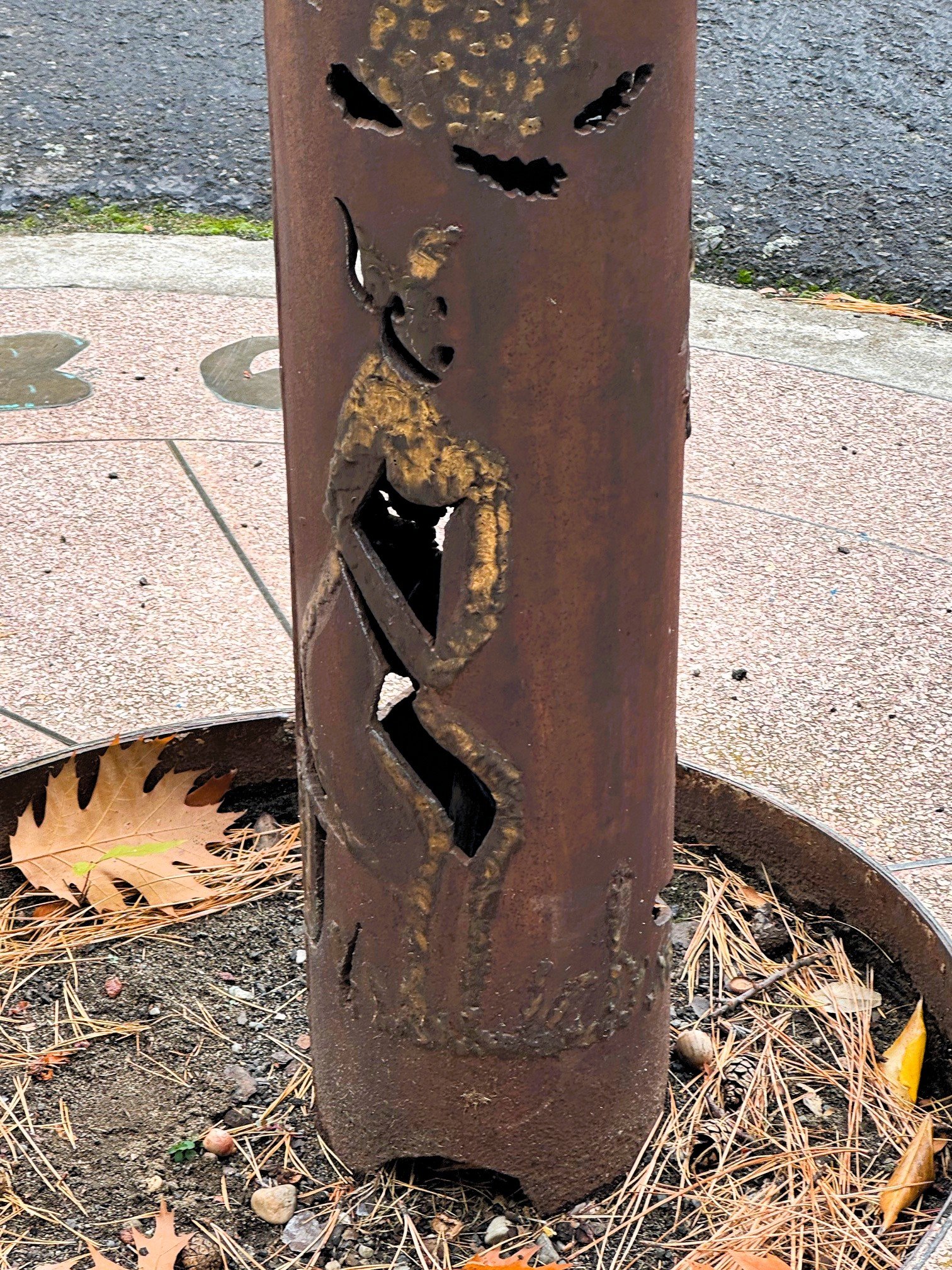
This kangaroo came about because the Australian Commissioner General “wanted to be sure that we showed a kangaroo at rest,” according to Sister Paula. “He’s a great big one. He’s just sitting there.”
At the end of 1974, Australia announced its intention to leave a gift on the site where its pavilion had stood.(1) As Commissioner General William Worth said:(2)
Although the Australian Pavilion will come down after Expo, we have plans in hand to put a sundial on the spot where our pavilion now stands, as a gift to the City of Spokane in commemoration of Australia’s participation.”
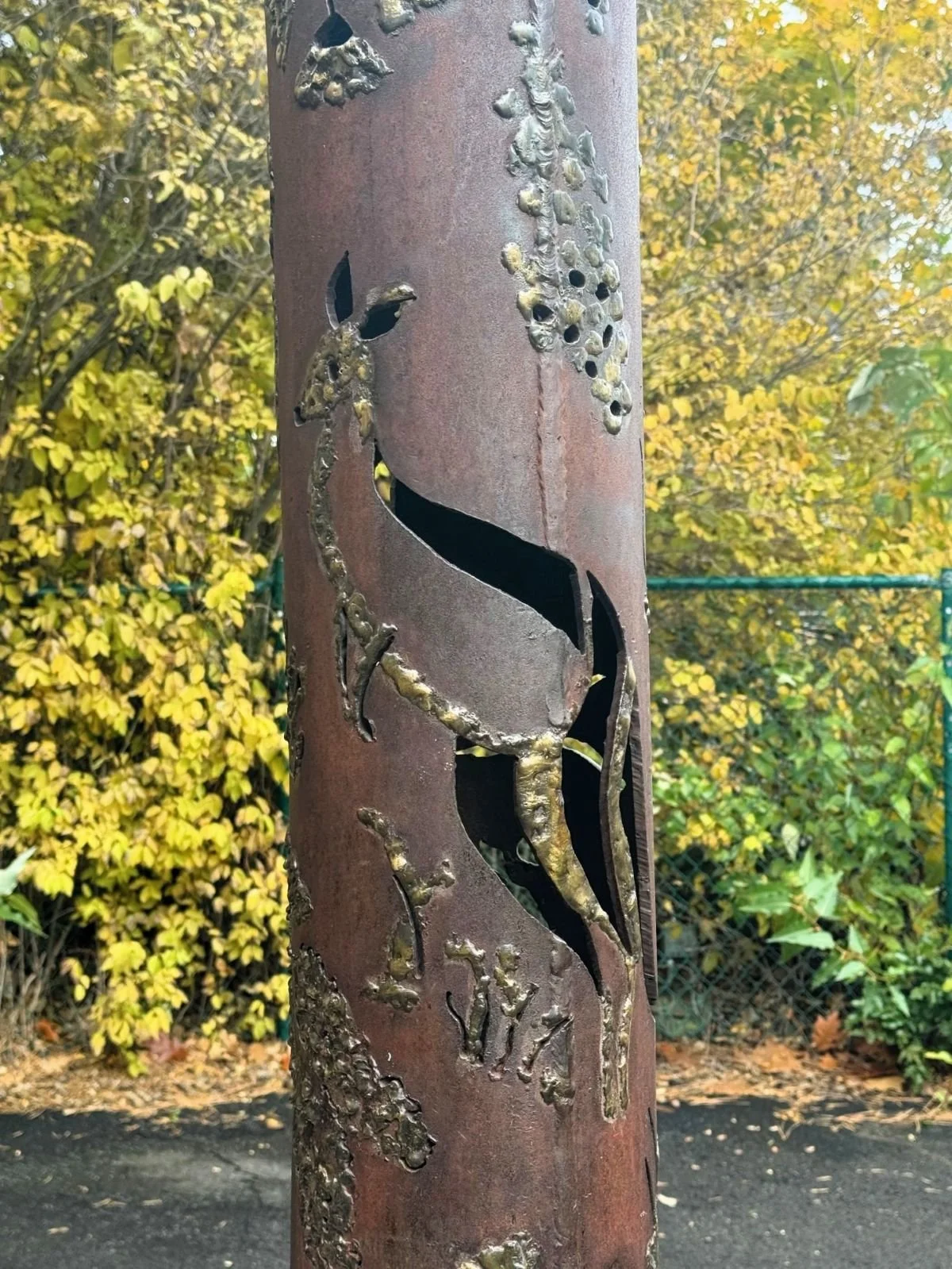
The sundial was created by Spokane artist Sister Paula Mary Turnbull, who also created the iconic garbage goat.. She conferred with Commissioner General Worth about the design, which included animals and plants indigenous to Australia: “koalas, an emu, a grass owl, a squirrel glider, a ring-tailed possum, and a parrot. Flower varieties included two kinds of wattle or acacia (Australia has 600 species), two of Australia’s 50 species of banksia and two of its 600 species of eucalyptus, in addition to Dowerin roses, Grerillea leucopteris, scarlet banksia, and red flowering gum.” (4)
The hollow gnomon (pillar) of the sundial was manufactured in New York from Australian steel. Sister Paula cut the animal designs with a torch and used a process of “brazing bronze” to apply the highlights. While the sundial is set up to roughly track the passage of time, the size of the numbers and the size of the shadow cast by the pillar mean that it is more of an artistic work than a precise timekeeping device.


The sundial was unveiled on September 25, 1976. Attendees at the unveiling included Australian Consul General John D. McCredie, King F. Cole, President of the Spokane Park Board Donald L. Schoedel, and Spokane Mayor David H. Rodgers.(5) Australian musicians Rolf Harris and Helen Reddy, each of whom had performed at Expo ‘74, sent congratulatory telegrams to the mayor’s office. In his, Harris joked that Australia would next give Spokane a “mondial,” then a “tuesdial,” etc. until Spokane had “an entire set.”
Australian Commissioner General William Worth was not present in person, but sent a letter that was read at the ceremony. He noted in it that the Australia Pavilion at Expo ‘74 was one of Australia’s first acts of participation in the American Bicentennial celebrations, and that this sundial would be one of their last.



An article from 2007 describes the corner of the park where the Australia sundial stands as having fallen into “polite ruin” and become a “storage area.”(6) Plans for remodeling and refreshing that area of the park were discussed. Further park renovations in the 2020s resulted in the Australia sundial being blocked off from public access for some time. However, as of 2025, it is again accessible.
While the Australia Sundial is often classed among the Expo ‘74 elements remaining at Riverfront Park, it was not actually a part of the fair itself, having come along two years later. Nonetheless, it serves as a charming reminder of the Australia Pavilion. Visitors to Riverfront Park can find it near the Upper Spokane Falls Dam and the wooden bridge that connects Havermale Island to the north bank of the river, opposite the Centennial Hotel. (Google Maps link here.)
References:
(1) “Departing Australian aide praises Expo’s endeavors.” (December 5, 1974.) Spokesman-Review, p. 15. Newspapers.com link.
(2) Powers, D. R. (October 6, 1974.) “Australia to give sundial.) Spokesman-Review, p. 6. Newspapers.com link.
(3) Powers, D. R. (June 29, 1975.) “Sundial on way with kangaroos.” Spokesman-Review, p. 11. Newspapers.com link.
(4) Parsons, O. J. (September 19, 1976.) “Australian sundial’s dedication Friday.” Spokesman-Review, p. 56. Newspapers.com link.
(5) Young, Larry. (September 25. 1976.) “Sundial last bicentennial act.” Spokesman-Review, p. 15. Newspapers.com link.
(6) Prager, Mike. (May 29, 2007.) “Getting a new look.” Spokesman-Review, p. 5. Newspapers.com link.